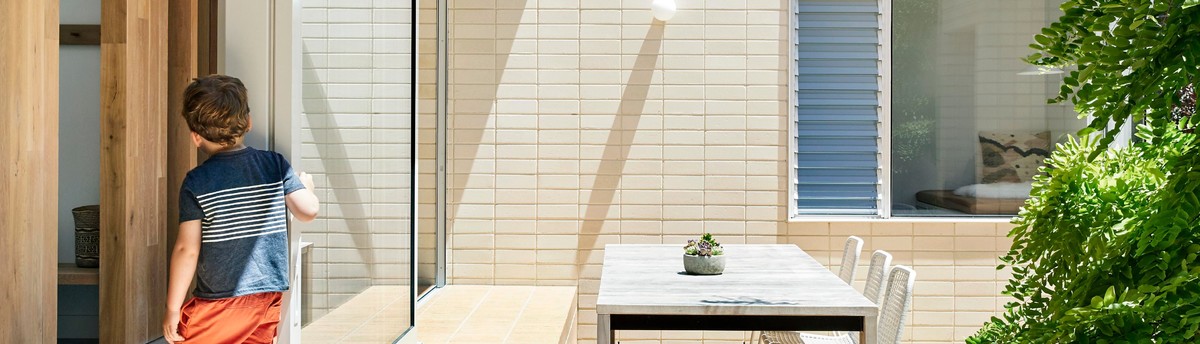
Project: Bisley Place House ft. Austral Bricks
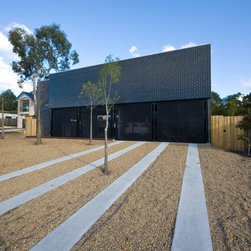
At the end of Bisley Place, James Russell Architect has designed a house that is a solid demonstration of the benefits of opening to the street. In contrast to the surrounding empty streets, children here are running to and fro; not just the inhabitants, but neighborhood children, visitors from across fences.
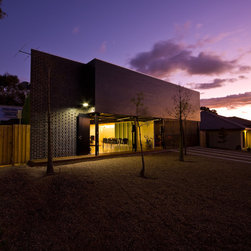
The aroma of fresh cooking carries unobstructed on the breeze from courtyard to curb.The ritual of cooking and meals happens right here on the street edge, a place for community. Building outdoor circulation through sites and along boundaries also allows for enjoyment of south-east Queensland’s benign climate.
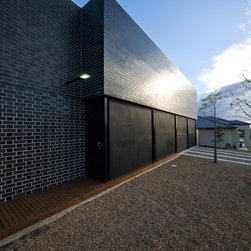
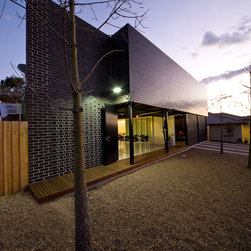
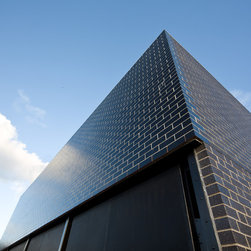
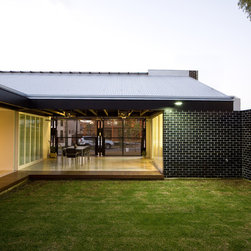
At the Bisley Place House, the outdoors and the indoors cease to be separate.The envelope is robust and permanent, with adaptable glazing, walls and landscape. Structural face brickwork and concrete make up the dwelling’s outer sleeve.These are materials that are inherently strong, self-finished, and can withstand diverse and exceptional weather conditions.
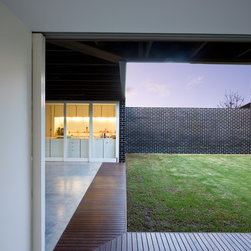
The inhabitant is therefore able to create and recreate their own space by manipulating skins – doors, windows and curtains – to alternate between internal and external use.
The materials and making of space is honest and efficient, a nod to the functionality of industrial building. But, more significantly, the dwelling manages also to return to the original definition of a home: a unity with place and environment, a coalescence of community.
The aroma of fresh cooking carries unobstructed on the breeze from courtyard to curb.The ritual of cooking and meals happens right here on the street edge, a place for community. Building outdoor circulation through sites and along boundaries also allows for enjoyment of south-east Queensland’s benign climate.
At the Bisley Place House, the outdoors and the indoors cease to be separate.The envelope is robust and permanent, with adaptable glazing, walls and landscape. Structural face brickwork and concrete make up the dwelling’s outer sleeve.These are materials that are inherently strong, self-finished, and can withstand diverse and exceptional weather conditions.
The inhabitant is therefore able to create and recreate their own space by manipulating skins – doors, windows and curtains – to alternate between internal and external use.
The materials and making of space is honest and efficient, a nod to the functionality of industrial building. But, more significantly, the dwelling manages also to return to the original definition of a home: a unity with place and environment, a coalescence of community.