
How Colour Shapes Your Child's Early Years
Why colourful kids spaces not only look great, but are an important factor in your child’s development...even from birth

Colour, it’s one of the most noticeable attributes of the world around us. For babies and small children, understanding colour is an essential building block they will use for learning in all areas of their life. So when it comes to designing kids’ spaces, colour is one of the most important elements to consider. Not only does colour play an important role in the overall aesthetic of a space, it can also impact an individual’s mood, emotional wellbeing, productivity, learning and behaviour.
0 to 3 months
Research from the likes of the Smith-Kettlewell Eye Research Institute in San Francisco, amongst others, has shown that in the first few months of life, a newborn baby can only see primarily in shades of black, grey and white.
For this reason, a monochrome colour scheme filled with contrasting patterns and shapes provides a newborn baby with the best form of visual stimulation.
The high visual contrast of black and white in a monochrome nursery and the use of these two colours in different shapes and patterns (as seen here) sends the strongest visual signals to a baby’s brain, according to the Dr. Sears Wellness Institute. They further state that stronger signals mean more brain growth and faster visual development.
As a result, creating a monochrome nursery for the first few months of life provides a visually stimulating environment that is said to boost your child’s attention span and curiosity, while also improving memory, and nervous system development.
Tip: To achieve a similar look without committing to wallpaper, try bedding, throws and rugs in contrasting black and white patterns.
Research from the likes of the Smith-Kettlewell Eye Research Institute in San Francisco, amongst others, has shown that in the first few months of life, a newborn baby can only see primarily in shades of black, grey and white.
For this reason, a monochrome colour scheme filled with contrasting patterns and shapes provides a newborn baby with the best form of visual stimulation.
The high visual contrast of black and white in a monochrome nursery and the use of these two colours in different shapes and patterns (as seen here) sends the strongest visual signals to a baby’s brain, according to the Dr. Sears Wellness Institute. They further state that stronger signals mean more brain growth and faster visual development.
As a result, creating a monochrome nursery for the first few months of life provides a visually stimulating environment that is said to boost your child’s attention span and curiosity, while also improving memory, and nervous system development.
Tip: To achieve a similar look without committing to wallpaper, try bedding, throws and rugs in contrasting black and white patterns.
In this nursery, the same developmental benefits have been achieved in the monochrome use of grey, black and white.
The gorgeous mural combined with the chevron curtains provides an excellent source of visual stimulation for a newborn baby.
The slight pop of colour in muted yellow on the mural and floor rug also allows for a great starting point to introduce more colour as baby’s sight develops.
The gorgeous mural combined with the chevron curtains provides an excellent source of visual stimulation for a newborn baby.
The slight pop of colour in muted yellow on the mural and floor rug also allows for a great starting point to introduce more colour as baby’s sight develops.
3 to 6 months
As your baby continues to grow, the inclusion of colour in their nursery plays an important factor in their development.
By three months of age, experts say most babies are able to see colour, with a preference for bright primary colours for brain stimulation.
The fantastic thing about starting with a monochrome colour base is that you can introduce almost any colour and it will complement your existing decor.
The pops of pink and yellow in this nursery are a perfect example of how to slowly bring primary colours into a nursery. You can add colour through decor such as lamps, cushions and throws for similar effect.
While I love the painted striped yellow ceiling of this room (excellent for visual and cognitive stimulation) it could be time-consuming to create and difficult to conceal when an update or mini-makeover is needed. A simple way to create a similar effect can be achieved by placing some decals on the ceiling, instead of the walls. As baby grows and spends less time looking above, you can simply remove the decals and place them on a feature wall.
Tip: There are many companies who now create an excellent array of decals using a specialised adhesive that does not damage painted surfaces.
As your baby continues to grow, the inclusion of colour in their nursery plays an important factor in their development.
By three months of age, experts say most babies are able to see colour, with a preference for bright primary colours for brain stimulation.
The fantastic thing about starting with a monochrome colour base is that you can introduce almost any colour and it will complement your existing decor.
The pops of pink and yellow in this nursery are a perfect example of how to slowly bring primary colours into a nursery. You can add colour through decor such as lamps, cushions and throws for similar effect.
While I love the painted striped yellow ceiling of this room (excellent for visual and cognitive stimulation) it could be time-consuming to create and difficult to conceal when an update or mini-makeover is needed. A simple way to create a similar effect can be achieved by placing some decals on the ceiling, instead of the walls. As baby grows and spends less time looking above, you can simply remove the decals and place them on a feature wall.
Tip: There are many companies who now create an excellent array of decals using a specialised adhesive that does not damage painted surfaces.
6 to 12 months
Around the age of 6-8 months, a baby’s colour vision is well developed. It is during this time that you may want to introduce a different colour scheme into your child’s nursery.
This transition can be gradually achieved by the simple placement of a wall art, toys and books. There is no need to change everything, you can easily add colour by using your child’s existing toys or books as functional decor items.
Around the age of 6-8 months, a baby’s colour vision is well developed. It is during this time that you may want to introduce a different colour scheme into your child’s nursery.
This transition can be gradually achieved by the simple placement of a wall art, toys and books. There is no need to change everything, you can easily add colour by using your child’s existing toys or books as functional decor items.
When planning a nursery, it is important to find a colour scheme that also provides the right balance of stimulation and relaxation to allow for a restful sleep space.
The use of muted green is a geat feature in this nursery. This colour is echoed throughout the scheme in the wallpaper, cushions, throws and rug. The bold, striped colours of the rug also introduce primary colours into the space to help stimulate sensory development in a subtle yet non-obtrusive way.
The use of muted green is a geat feature in this nursery. This colour is echoed throughout the scheme in the wallpaper, cushions, throws and rug. The bold, striped colours of the rug also introduce primary colours into the space to help stimulate sensory development in a subtle yet non-obtrusive way.
In this nursery a different colour palette has been utilised to project a sentiment of safety, security and love. The patterned wallpaper continues to provide visual and cognitive stimulation for a growing baby.
This nursery also illustrates how to expose your developing baby to different hues, shades and tints of colour (seen here in the the chair, artwork, paint and bedding), helping a baby’s brain to make important colour connections early on in life.
This nursery also illustrates how to expose your developing baby to different hues, shades and tints of colour (seen here in the the chair, artwork, paint and bedding), helping a baby’s brain to make important colour connections early on in life.
1 to 2 years
Your child’s oral language development begins to emerge between one and two years. It is during this time that a child will also begin to differentiate between colours (around 18 months).
For babies and toddlers of this age, I like to introduce a few more colours to stimulate cognitive development.
In this nursery there is a multitude of opportunities for a parent to actively engage in colour recognition games with their toddler. By using simple decor items like coloured wall prints, a cute garland or multi-coloured cushions, you are able to create a space that is fun, vibrant and developmentally appropriate.
Your child’s oral language development begins to emerge between one and two years. It is during this time that a child will also begin to differentiate between colours (around 18 months).
For babies and toddlers of this age, I like to introduce a few more colours to stimulate cognitive development.
In this nursery there is a multitude of opportunities for a parent to actively engage in colour recognition games with their toddler. By using simple decor items like coloured wall prints, a cute garland or multi-coloured cushions, you are able to create a space that is fun, vibrant and developmentally appropriate.
3 to 4 years
By approximately three to four years of age, a child will begin to recognise, identify and name basic colours.
The simple placement of different coloured items such as beanbags, toys or bedding in your child’s room enables you to help strengthen and reinforce these basic colour recognition skills.
By approximately three to four years of age, a child will begin to recognise, identify and name basic colours.
The simple placement of different coloured items such as beanbags, toys or bedding in your child’s room enables you to help strengthen and reinforce these basic colour recognition skills.
In the image above, the accents of red in the lamp, rug, cushion and Eames elephant not only create a cohesive and beautiful space but provide opportunities for a parent and child to engage in colour-related learning games.
This space allows a child to match colours, play colour eye-spy games (eye-spy with a colour as opposed to a letter), and can develop their oral language skills as they use colour as a learning tool to describe and communicate with others.
This space allows a child to match colours, play colour eye-spy games (eye-spy with a colour as opposed to a letter), and can develop their oral language skills as they use colour as a learning tool to describe and communicate with others.
5+ years
As children grow older, they begin to develop a preference for certain colours. As an early childhood teacher, I believe it is an important part of their personal growth and creative expression to provide them with a space that reflects their developing personality.
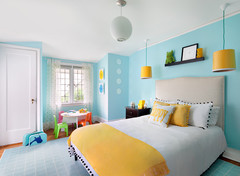
This colourful room belonging to my daughter was an extension of her bright, cheerful personality. It was a space for her to be creative, have fun with her friends and engage in pretend play. By keeping all of the furniture in her room a neutral white colour, it allowed me to introduce her favourite colour, turquoise, as a feature wall. Considering her personal tastes, we then used the bright, cheerful colour palette of the cushion on her bed, allowing us to introduce other pops of colour (in throws, cushions, rugs etc.).
This room has since been changed to suit my daughter’s growing needs, but because the base of our furniture was white, a simple coat of paint on the wall and a few changes here and there allowed us to create a whole new look.
As children grow older, they begin to develop a preference for certain colours. As an early childhood teacher, I believe it is an important part of their personal growth and creative expression to provide them with a space that reflects their developing personality.
This colourful room belonging to my daughter was an extension of her bright, cheerful personality. It was a space for her to be creative, have fun with her friends and engage in pretend play. By keeping all of the furniture in her room a neutral white colour, it allowed me to introduce her favourite colour, turquoise, as a feature wall. Considering her personal tastes, we then used the bright, cheerful colour palette of the cushion on her bed, allowing us to introduce other pops of colour (in throws, cushions, rugs etc.).
This room has since been changed to suit my daughter’s growing needs, but because the base of our furniture was white, a simple coat of paint on the wall and a few changes here and there allowed us to create a whole new look.
This is the beauty of colour, it surrounds us in our everyday life. It is something we experience every day, and it has a subconscious effect on how we live our day-to-day lives. It is a creative reflection of who we are and it was one of the very first things you and I needed to learn about as we traveled through our early childhood years.
Note: Always remove toys and cushions from baby’s bed when sleeping to ensure safe sleep practices.
More:
Must-Haves in a Teenage Girl’s Room
Zany Bunk Beds Your Kids Will Love
Tell us:
How do you use colour in your little one’s bedroom or playroom? Share you pics and thoughts in the Comments.
Note: Always remove toys and cushions from baby’s bed when sleeping to ensure safe sleep practices.
More:
Must-Haves in a Teenage Girl’s Room
Zany Bunk Beds Your Kids Will Love
Tell us:
How do you use colour in your little one’s bedroom or playroom? Share you pics and thoughts in the Comments.
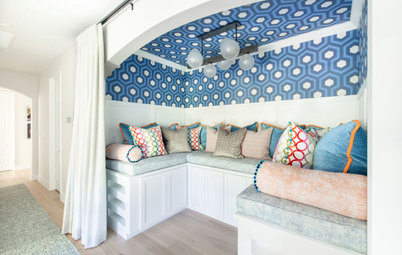

By teaching your child about colour (including shades, tones and hues), you will also be helping them to use colour as a means of creative expression in all aspects of life.
On top of that, children will learn to use colour as a visual cue to identify danger (red) and distinguish hot from cold. But the role in which colour has on your child’s development doesn’t stop there – the list could go on forever.
Here are some simple ways that you can use colour in children’s interiors with the confidence that you are not only creating a beautiful space, but that it is also great for your child’s development.