
A Guide to Ambient Lighting, and How to Get It Right
Here are some dos and don'ts that will come in handy when selecting surround lighting

In a nutshell, ambient lighting is what helps you from tripping over things – that’s how important it is. It’s the light that substitutes for natural light in a room, the light that illuminates it. Of the three types of lighting that a well-designed home should have, ambient lighting (or general lighting) is the most basic. The other two types – task and accent lighting – add layers to ambient lighting. A room requires all three and the degree of usage of each depends on the size of the room and your requirements. Here we discuss this most common form of lighting, the kinds of fixtures used for it and some tips on how best to use them.
Cove lights are especially useful to highlight decorative ceilings like the one in this bedroom.
Since they are concealed, cove lights are usually strips, either LED or fluorescent, often in the form of a rope or a strip.
Do use energy-efficient LED lights as cove lighting requires a longish series of bulbs for uninterrupted lighting.
Don’t use bulbs that are too yellow or too fluorescent.Warm white is best for a warm ambience. Dimmers come in handy if the light is too bright.
Check out these 10 reasons to say yes to LED lights
Since they are concealed, cove lights are usually strips, either LED or fluorescent, often in the form of a rope or a strip.
Do use energy-efficient LED lights as cove lighting requires a longish series of bulbs for uninterrupted lighting.
Don’t use bulbs that are too yellow or too fluorescent.Warm white is best for a warm ambience. Dimmers come in handy if the light is too bright.
Check out these 10 reasons to say yes to LED lights
Recessed lighting
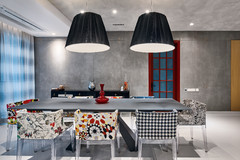
Recessed lighting is typically used to spread light over a large surface. The fixture is hidden in a hollow in the ceiling, with the rim amd the bulb sitting flush with its surface. They are also called downlights, for obvious reasons. Here, while recessed lights illuminate the whole room, they work in conjunction with the horizontal lights of the pendants, which are meant to light up the dining table.
Recessed lighting is typically used to spread light over a large surface. The fixture is hidden in a hollow in the ceiling, with the rim amd the bulb sitting flush with its surface. They are also called downlights, for obvious reasons. Here, while recessed lights illuminate the whole room, they work in conjunction with the horizontal lights of the pendants, which are meant to light up the dining table.
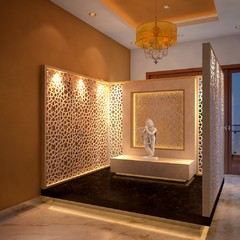
Certain recessed lights (also known as can lights), which can be swivelled, can also be used as spotlights. This little alcove is prettily lit up with recessed lights. The narrow beams of the lights serve to highlight the paintings while the wall sconce enhances the cosy feeling of this corner.
Recessed lights use two types of bulbs: directional (which direct and control light) or diffused.
Do use dimmers to create an ambience – and to control electricity bills.
Don’t place them too close together or in rows down the centre of a room, unless you are going for the airport runway look.
Recessed lights use two types of bulbs: directional (which direct and control light) or diffused.
Do use dimmers to create an ambience – and to control electricity bills.
Don’t place them too close together or in rows down the centre of a room, unless you are going for the airport runway look.
Track lights
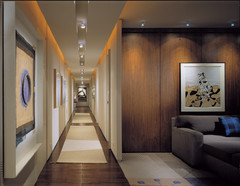
Track lighting is similar to recessed lighting, except the lights are externally placed. It is an easier option if you don’t want to cut up the ceiling. It allows for flexibility in size and position. Track lights can light up various parts of the room, depending on where they are directed. In this living room, tracks are used to light up the sitting space, while cove lights brighten up the walking area.
Track lighting is similar to recessed lighting, except the lights are externally placed. It is an easier option if you don’t want to cut up the ceiling. It allows for flexibility in size and position. Track lights can light up various parts of the room, depending on where they are directed. In this living room, tracks are used to light up the sitting space, while cove lights brighten up the walking area.
Chandeliers and pendants
A chandelier, apart from being statement jewellery for the home, is a central clustered light source. It will sparkle during the day when the sun hits it, and at night it allows light to bounce off its crystal fittings, reflecting a light that shimmers and dances across surrounding wall surfaces. Pendants are the contemporary equivalents of their starry counterparts. Chandeliers, particularly, usually need high ceilings to be used effectively (so as to spread a large amount of light to cover as much area as possible) – and aesthetically.
A chandelier, apart from being statement jewellery for the home, is a central clustered light source. It will sparkle during the day when the sun hits it, and at night it allows light to bounce off its crystal fittings, reflecting a light that shimmers and dances across surrounding wall surfaces. Pendants are the contemporary equivalents of their starry counterparts. Chandeliers, particularly, usually need high ceilings to be used effectively (so as to spread a large amount of light to cover as much area as possible) – and aesthetically.
Bathrooms often get step-motherly treatment where lighting is concerned. There’s no reason why they can’t have a chandelier of their own!
Do make sure your chandelier is the right size and is proportionate to the size of your room.
Don’t limit yourself to one chandelier/ large pendant per room. It’s okay to use two slightly smaller ones in a large space, rather than one huge fixture.
Ready to install a chandelier? Here’s how to get it done
Do make sure your chandelier is the right size and is proportionate to the size of your room.
Don’t limit yourself to one chandelier/ large pendant per room. It’s okay to use two slightly smaller ones in a large space, rather than one huge fixture.
Ready to install a chandelier? Here’s how to get it done
Do use track lights to highlight specific features of the room. In this sense, it can act as an accent light.
Don’t use it in traditional settings. Design-wise, track lights have a more modern feel.
Don’t use it in traditional settings. Design-wise, track lights have a more modern feel.
Wall sconces
A common type of lighting in Indian homes is the wall sconce that is fixed on a wall. They are versatile enough to be used for general lighting, task or accent lighting. They are also helpful in filling gaps, when another fixture, such as a pendant, doesn’t provide enough light for the whole room, like in this bathroom. Here, apart from illuminating the whole room, the wall sconces on either side of the mirror will help when applying make up.
A common type of lighting in Indian homes is the wall sconce that is fixed on a wall. They are versatile enough to be used for general lighting, task or accent lighting. They are also helpful in filling gaps, when another fixture, such as a pendant, doesn’t provide enough light for the whole room, like in this bathroom. Here, apart from illuminating the whole room, the wall sconces on either side of the mirror will help when applying make up.
Wall sconces are ideal for spaces such as this long thin corridor, where any other type of fixture would be a hard fit.
Do fix them at a level that they can’t be accidentally bumped into, but ideally not higher than 6.5 feet. They are as much meant to be seen as to see by.
Don’t use fixtures with sharp edges, especially if you plan to place them lower, say beside a bed.
Learn how to use wall sconces
Do fix them at a level that they can’t be accidentally bumped into, but ideally not higher than 6.5 feet. They are as much meant to be seen as to see by.
Don’t use fixtures with sharp edges, especially if you plan to place them lower, say beside a bed.
Learn how to use wall sconces
Torchieres
Not to be confused with floor lamps, torchieres have a shade that points upwards, illuminating the walls and the ceiling. They fall in the realm of uplights. For this reason they are also higher than the floor lamp, which are primarily downward-facing and used for task lighting. These bold torchieres are topped with flattened acrylic shades in a warm sunset hue, offsetting the copper-black finish. A handy foot-dimmer switch allows for easy control of light output.
Not to be confused with floor lamps, torchieres have a shade that points upwards, illuminating the walls and the ceiling. They fall in the realm of uplights. For this reason they are also higher than the floor lamp, which are primarily downward-facing and used for task lighting. These bold torchieres are topped with flattened acrylic shades in a warm sunset hue, offsetting the copper-black finish. A handy foot-dimmer switch allows for easy control of light output.
Torchieres are a fantastic addition for general lighting and have the great advantage that you can place them wherever you have a dark spot and an outlet.
Do use higher wattage energy-efficient CFL bulbs, so you can light up a larger area with just one lamp.
Don’t use halogen bulbs as they can get heated to very high temperatures, proving to be a safety hazard.
Read more:
What to Consider When Lighting Your Home
Tell us:
What kind of lighting have you installed in your home? Share in Comments below.
Do use higher wattage energy-efficient CFL bulbs, so you can light up a larger area with just one lamp.
Don’t use halogen bulbs as they can get heated to very high temperatures, proving to be a safety hazard.
Read more:
What to Consider When Lighting Your Home
Tell us:
What kind of lighting have you installed in your home? Share in Comments below.
Cove lights are a form of indirect lighting which are typically built into ledges or recesses in the ceiling or high on the walls of a room. Their aim is to provide overall diffused lighting as they direct light up towards the ceiling or down the adjacent walls.