Nirat
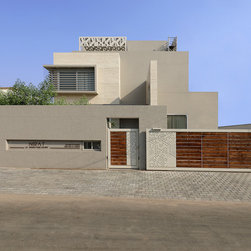
Nestled on a corner, between two meeting streets and houses, Nirat is a distinctive addition to the skyline of its sangam neighborhood. It belongs to the family of a Gujarati businessman who approached team Usine for an abode that imbued an understated luxury.
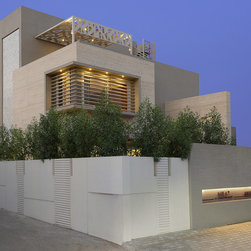
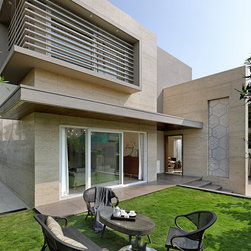
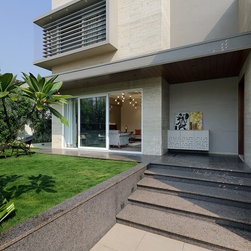
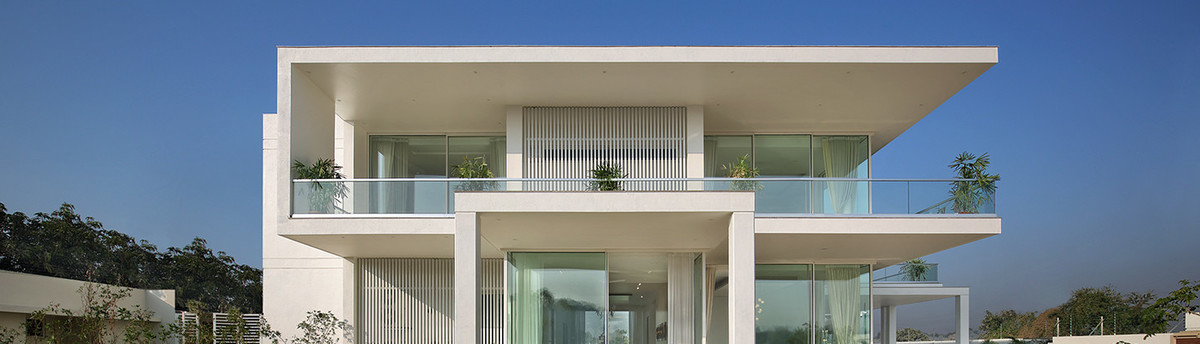
This 5,000 sq. ft. house is massed as a group of stepped cubes with solid planes and rectilinear punctures creating tiny visual pockets. Externally, the major volumes are colored in taupe with occasional tones of grays and whites to define a decidedly neutral and overall heat-deflecting built mass. The frontage facing the southwest is flanked with young trees that’ll soon grow out to serve the twin purpose of privacy and shade from the sun’s scorch.
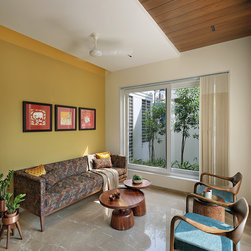
A compact yet generously set-up foyer precludes the views into the rest of the house. This allows the family to entertain the frequent work-related visitors without losing a much needed formal air. A warm yellow wall stands as both, a welcome and a religious tribute; the latter being further underlined by a set of Pichhwai paintings. This house has been endowed with many such allusions to Pichhwai art, which is a form of devotional art found on cloth or paper with the purpose of narrating tales of Lord Krishna to the illiterate.
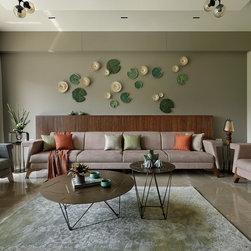
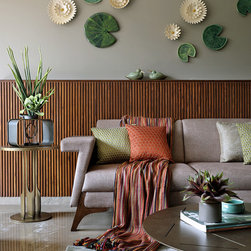
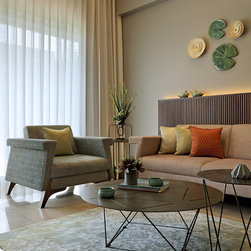
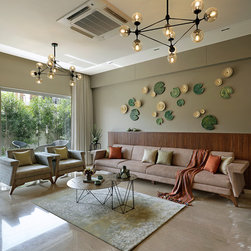
The spatial layout personifies a lifestyle that is rooted in conventional values with a longing for the new. For instance, the clients did not require separate formal and informal living rooms, as is the trend. They believed that all the space were to be used with an adaptive and accommodative sense of belonging; something unique to traditional family homes. Their living room is a mélange of neutrals, with hues of taupe ruling the walls and floors while the reticent plush sofas in beige are balanced up with a slight warming of orange and wooden hues. The plain painted wall acts as the murky water giving life to the white lotuses and green leaves, in ceramic, referencing the classic Pichhwai floral. The piece was conceptualized by Dixit Panchal and made by Artist Kavita.
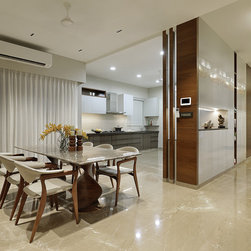
The passage that separates the foyer and the living room adjoins the kitchen and opens into the dining space. The white finished partition of this passage is designed with a meticulous slit that allows covert views from the cooking station into the living room: one can always know how many cups of tea should be underway!
Right above it, the ceiling is set with chandeliers which are essentially an assembly of amber colored glass drops suspended from translucent fabric boxes. These drops are reminiscent of Lord Krishna’s beloved peacock feathers and the light from them animates the otherwise subdued dining space.
The ground floor has a guest bedroom that is done in a clean, unencumbered manner to let the room feel more spacious than space constraints allowed. A combination of fabric paneling with three different patterns in gray and white covers the entire wall as it holds the room together.
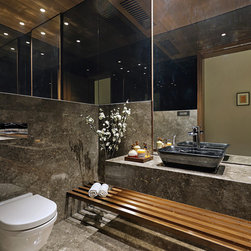
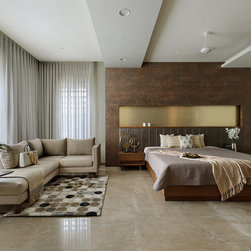
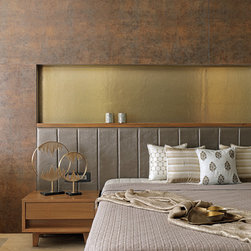
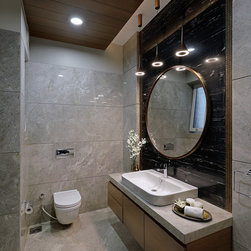
The material palette for the master bedroom, on the upper level, is much more diverse and richly textured. The central feature wall is composed of large coffee brown tiles with a gold sheeted rectangular recession fronted with a leather-bound headrest. The room also boasts of a seating area where a fawn colored sofa is flanked with floor to ceiling height windows that bring in copious daylight and a fluted false ceiling tops the seating to subtly delineate the interior volume. The bathroom is rendered in Italian marble with the mirror console backed in black vitrified tiles with inlays and light fixtures in copper.
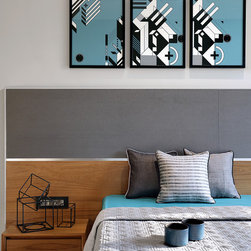
Their young son’s room dons a gray sandstone-finish laminate paired with geometric graphics and a hint of clean wooden details.
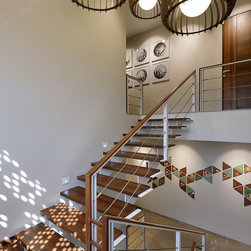
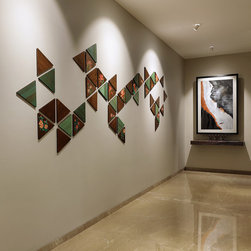
The common spaces of the house are steeped in more geometric abstractions underpinned with Pichhwai art such as the landing wall near the staircase is adorned with a triangulated mural depicting Indian flowers amongst wooden and green tiles. The staircase itself is bathed in a playful sciography of hexagonal cutouts that moves with sun’s time.
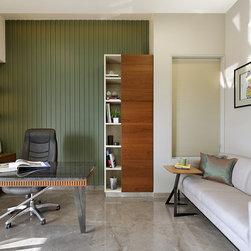
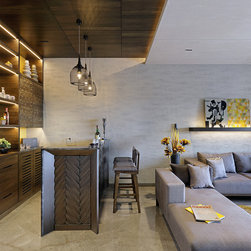
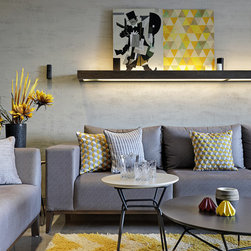
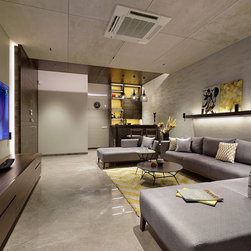
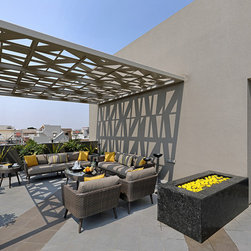
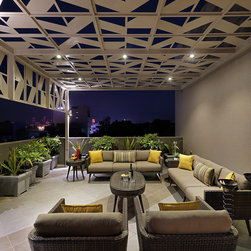
The second floor houses a chic family office for the times when the members needed to bring pressing business affairs home, for contemplation and consensus. This office is muted in terms of colors, which allows a clean underlay for wooden overtones to dictate a crisp sense of formality. The family entertainment room, on the same floor, is rendered in a soft gray which is relieved with measured bursts of yellows and blackened wood. The textured walls and paneled ceiling lend a brazen quality that is softened only by the yellow Aztec from Jaipur Rugs. This space spills out into a gazebo with shadows again at play over the cozy gray and yellow set-up.
Ultimately Nirat, with its clean straight-edged massing and keenly defused insides, is bespoke with an air of laid back charm and nonchalant luxury. It becomes reverent to traditions at one place and opens up for new ones at another; which is a value many homes yearn for.
This 5,000 sq. ft. house is massed as a group of stepped cubes with solid planes and rectilinear punctures creating tiny visual pockets. Externally, the major volumes are colored in taupe with occasional tones of grays and whites to define a decidedly neutral and overall heat-deflecting built mass. The frontage facing the southwest is flanked with young trees that’ll soon grow out to serve the twin purpose of privacy and shade from the sun’s scorch.
A compact yet generously set-up foyer precludes the views into the rest of the house. This allows the family to entertain the frequent work-related visitors without losing a much needed formal air. A warm yellow wall stands as both, a welcome and a religious tribute; the latter being further underlined by a set of Pichhwai paintings. This house has been endowed with many such allusions to Pichhwai art, which is a form of devotional art found on cloth or paper with the purpose of narrating tales of Lord Krishna to the illiterate.
The spatial layout personifies a lifestyle that is rooted in conventional values with a longing for the new. For instance, the clients did not require separate formal and informal living rooms, as is the trend. They believed that all the space were to be used with an adaptive and accommodative sense of belonging; something unique to traditional family homes. Their living room is a mélange of neutrals, with hues of taupe ruling the walls and floors while the reticent plush sofas in beige are balanced up with a slight warming of orange and wooden hues. The plain painted wall acts as the murky water giving life to the white lotuses and green leaves, in ceramic, referencing the classic Pichhwai floral. The piece was conceptualized by Dixit Panchal and made by Artist Kavita.
The passage that separates the foyer and the living room adjoins the kitchen and opens into the dining space. The white finished partition of this passage is designed with a meticulous slit that allows covert views from the cooking station into the living room: one can always know how many cups of tea should be underway!
Right above it, the ceiling is set with chandeliers which are essentially an assembly of amber colored glass drops suspended from translucent fabric boxes. These drops are reminiscent of Lord Krishna’s beloved peacock feathers and the light from them animates the otherwise subdued dining space.
The ground floor has a guest bedroom that is done in a clean, unencumbered manner to let the room feel more spacious than space constraints allowed. A combination of fabric paneling with three different patterns in gray and white covers the entire wall as it holds the room together.
The material palette for the master bedroom, on the upper level, is much more diverse and richly textured. The central feature wall is composed of large coffee brown tiles with a gold sheeted rectangular recession fronted with a leather-bound headrest. The room also boasts of a seating area where a fawn colored sofa is flanked with floor to ceiling height windows that bring in copious daylight and a fluted false ceiling tops the seating to subtly delineate the interior volume. The bathroom is rendered in Italian marble with the mirror console backed in black vitrified tiles with inlays and light fixtures in copper.
Their young son’s room dons a gray sandstone-finish laminate paired with geometric graphics and a hint of clean wooden details.
The common spaces of the house are steeped in more geometric abstractions underpinned with Pichhwai art such as the landing wall near the staircase is adorned with a triangulated mural depicting Indian flowers amongst wooden and green tiles. The staircase itself is bathed in a playful sciography of hexagonal cutouts that moves with sun’s time.
The second floor houses a chic family office for the times when the members needed to bring pressing business affairs home, for contemplation and consensus. This office is muted in terms of colors, which allows a clean underlay for wooden overtones to dictate a crisp sense of formality. The family entertainment room, on the same floor, is rendered in a soft gray which is relieved with measured bursts of yellows and blackened wood. The textured walls and paneled ceiling lend a brazen quality that is softened only by the yellow Aztec from Jaipur Rugs. This space spills out into a gazebo with shadows again at play over the cozy gray and yellow set-up.
Ultimately Nirat, with its clean straight-edged massing and keenly defused insides, is bespoke with an air of laid back charm and nonchalant luxury. It becomes reverent to traditions at one place and opens up for new ones at another; which is a value many homes yearn for.
Project Year: 2019