APIDEL
Our world shrinks into a global village and the tech business is the frontrunner of this transformation. One such runner would be APIDEL, a multinational firm with offices in the USA, Canada, and India. The office in India is located in Vadodara and follows the same working hours as that of its western counterparts. This meant that they worked in the wee hours from 6 pm to 4 am IST, through the evening and night. This allowed a definite save from the city’s unsparing heat during the day but it also meant losing out on natural daylight completely. The employees deserved an office space that would respond to this nocturnal functioning in a comforting yet energizing manner. They approached Usine with their top floor workspace seeking a worthy resolution for their unique design situation.
“Since the spaces were not going to experience any natural light, we aimed to replicate the diurnal variations through different qualities of artificial lights,” recalls Jiten, while discussing how they designed the spaces for optimum user comfort with a combination of hard and soft lighting. Upon finding that the APIDEL employees were majorly a pack of young 20-somethings, the design team decided to give each of these professional spaces a fresh and youthful buzz to ensure a sense of lively involvement. They chose to add a punch of yellow to the overall neutral shades. In almost every culture yellow represents sunshine, happiness, and warmth; the color of sunflowers, canaries, and bees.
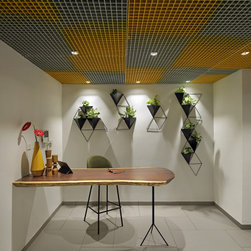
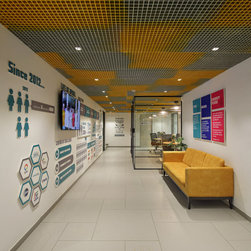
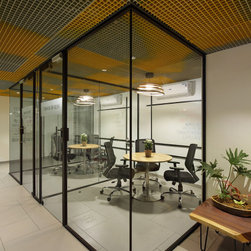
The office was not aimed to entertain any clients and so need of a reception area was limited to serving as a transition space between the entrance and the working spaces. The ceiling of this zone is done with metal grating painted in a quirky yet formal combination of yellow and grey. The grating imparts a weightless porous feel to space while efficiently concealing services within it. The otherwise neutral colored, square-patterned flooring is peppered with work-related symbols engraved on the smaller tiles. A new employee at APIDEL would find his way from there to a mustard yellow sofa which faces a wall with a graphic depiction of the company profile, surrounding a television screen for some added momentum. This setting is accompanied by a couple of interviewing cabins that sit as clean glass cubicles, outlined with only a slim black framing.
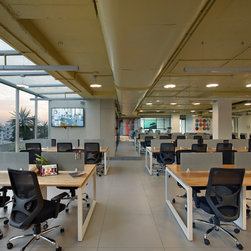
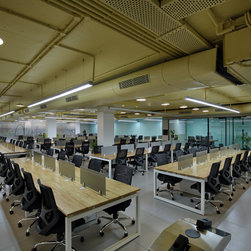
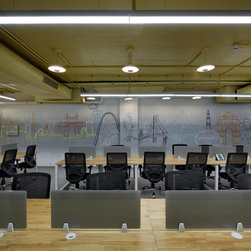
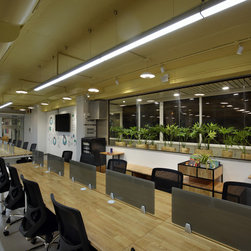
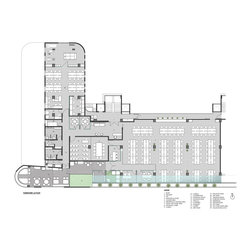
The workspace was designed with austerity that a tight budget often entails, to enhance team connections. All the work stations have wooden tops to minimize reflected glare from the system of task lights and the regular work lights. Since a lot of people would work there together, the absence of a false ceiling allows a larger experiential volume while laying the services bare. These exposed services are painted in a pale yellow that combines seamlessly with the wooden and black overtones in the furniture as well as the muted flooring. The walls along this workspace have several interesting murals and graphics done on them. The longer one has the skylines of the US, Canada, and India upon it by Dixit Panchal, which vividly reflects incoming light in grey and silver tones, almost suggestive of movement. Another wall sports a set of clocks displaying the standard times from those time zones, like a reminder of the company’s international connects. An informal area, having a set of seats paired with a shelf of potted plants, abuts the central workspace to serve as a spot for short breaks and small talks.
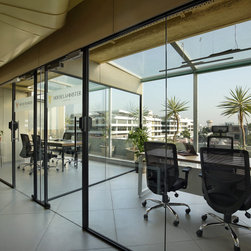
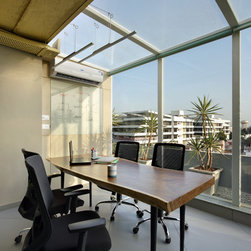
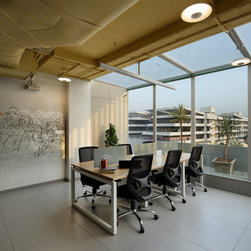
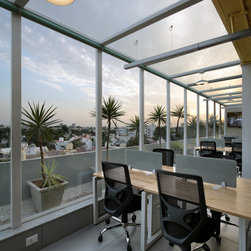
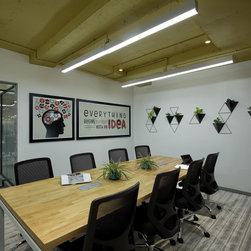
Apart from a usual conference room, the office has a designated room for smaller groups to meet and discuss individual team matters with a back painted glass to jot down plans and deadlines, right next to the night sky views. Next to this lies a series of four open workstations that enjoy not only the full-length windows that run along the façade but also a portion of the glass ceiling and hence this bay affords the maximum transparency towards the nighttime skies. The MD cabin has full-length glass windows that provide equally generous views of the city at night. It has been raised a foot above the overall level to provide visual reach over the workspace. Right in front of this cabin sits a painting of a team lifting up a mountain and a suggestion board; a direct attempt towards both, inspiring and involving the young and bustling employees.
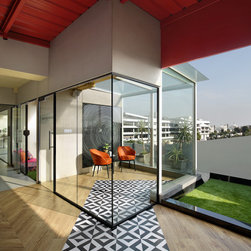
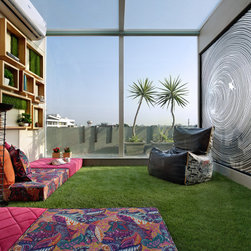
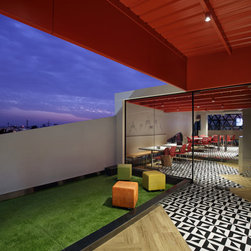
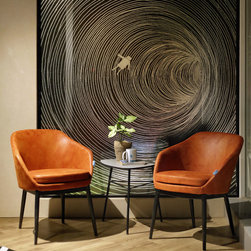
From that point, one is led to the informal team lounge and the smoking zone, divided by a glass painting, of a human form receding into the abyss. From the lounge’s side, the abyss seems to denote deeper thoughts or rather just sleep while from the smokers’ side it surely is the smoke. The lounge is adorned with large colorful floor cushions on turf carpeting while the smoker’s den just features a couple of brown upholstered chairs, creating a sense of brooding with the moderated statement. This lounge and smoke zone protrude as lit up glass masses into the twilight sky, playing with partial reflections and colors.
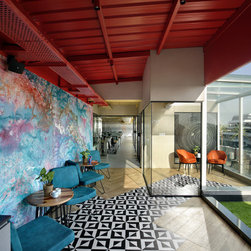
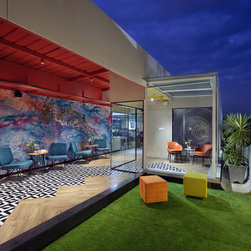
These spaces are faced by a semi-open seating area that overlooks a patch of green terrace lawn. It opens into a fresh and welcome burst of colors by a 30’X8’ canvas painting also by Dixit Panchal and a set of cozy lounge chairs in cobalt blue, the APIDEL color. The flooring is jazzed up with classic black and white checkers in diagonals, highlighting the paths a user would take. This seating area ends into a dining space and both of these are topped off with a ceiling painted in an appetizing tomato red.
This office comes together as a combination of places with definite and distinctive color palettes, dotted with plants and greens: the formals spaces in browns and grays with pops of yellow, while the more informal ones seeped in the vigor of colors and patterns.
“Since the spaces were not going to experience any natural light, we aimed to replicate the diurnal variations through different qualities of artificial lights,” recalls Jiten, while discussing how they designed the spaces for optimum user comfort with a combination of hard and soft lighting. Upon finding that the APIDEL employees were majorly a pack of young 20-somethings, the design team decided to give each of these professional spaces a fresh and youthful buzz to ensure a sense of lively involvement. They chose to add a punch of yellow to the overall neutral shades. In almost every culture yellow represents sunshine, happiness, and warmth; the color of sunflowers, canaries, and bees.
The office was not aimed to entertain any clients and so need of a reception area was limited to serving as a transition space between the entrance and the working spaces. The ceiling of this zone is done with metal grating painted in a quirky yet formal combination of yellow and grey. The grating imparts a weightless porous feel to space while efficiently concealing services within it. The otherwise neutral colored, square-patterned flooring is peppered with work-related symbols engraved on the smaller tiles. A new employee at APIDEL would find his way from there to a mustard yellow sofa which faces a wall with a graphic depiction of the company profile, surrounding a television screen for some added momentum. This setting is accompanied by a couple of interviewing cabins that sit as clean glass cubicles, outlined with only a slim black framing.
The workspace was designed with austerity that a tight budget often entails, to enhance team connections. All the work stations have wooden tops to minimize reflected glare from the system of task lights and the regular work lights. Since a lot of people would work there together, the absence of a false ceiling allows a larger experiential volume while laying the services bare. These exposed services are painted in a pale yellow that combines seamlessly with the wooden and black overtones in the furniture as well as the muted flooring. The walls along this workspace have several interesting murals and graphics done on them. The longer one has the skylines of the US, Canada, and India upon it by Dixit Panchal, which vividly reflects incoming light in grey and silver tones, almost suggestive of movement. Another wall sports a set of clocks displaying the standard times from those time zones, like a reminder of the company’s international connects. An informal area, having a set of seats paired with a shelf of potted plants, abuts the central workspace to serve as a spot for short breaks and small talks.
Apart from a usual conference room, the office has a designated room for smaller groups to meet and discuss individual team matters with a back painted glass to jot down plans and deadlines, right next to the night sky views. Next to this lies a series of four open workstations that enjoy not only the full-length windows that run along the façade but also a portion of the glass ceiling and hence this bay affords the maximum transparency towards the nighttime skies. The MD cabin has full-length glass windows that provide equally generous views of the city at night. It has been raised a foot above the overall level to provide visual reach over the workspace. Right in front of this cabin sits a painting of a team lifting up a mountain and a suggestion board; a direct attempt towards both, inspiring and involving the young and bustling employees.
From that point, one is led to the informal team lounge and the smoking zone, divided by a glass painting, of a human form receding into the abyss. From the lounge’s side, the abyss seems to denote deeper thoughts or rather just sleep while from the smokers’ side it surely is the smoke. The lounge is adorned with large colorful floor cushions on turf carpeting while the smoker’s den just features a couple of brown upholstered chairs, creating a sense of brooding with the moderated statement. This lounge and smoke zone protrude as lit up glass masses into the twilight sky, playing with partial reflections and colors.
These spaces are faced by a semi-open seating area that overlooks a patch of green terrace lawn. It opens into a fresh and welcome burst of colors by a 30’X8’ canvas painting also by Dixit Panchal and a set of cozy lounge chairs in cobalt blue, the APIDEL color. The flooring is jazzed up with classic black and white checkers in diagonals, highlighting the paths a user would take. This seating area ends into a dining space and both of these are topped off with a ceiling painted in an appetizing tomato red.
This office comes together as a combination of places with definite and distinctive color palettes, dotted with plants and greens: the formals spaces in browns and grays with pops of yellow, while the more informal ones seeped in the vigor of colors and patterns.
Project Year: 2019