
Urban Alchemy 9
How does one create architecture that breathes? How does one embody the same characteristics as that of a tree in nature to architecture? These were just some of the questions that we tried to answer through this group housing project. Celebrated architect Frank Lloyd Wright once said that “Organic buildings are the strength and lightness of the spiders’ spinning, buildings qualified by light, bred by native character to environment, married to the ground.” With this thought in mind we began designing a space which acts as a natural envelope for people to reside in.
The project comprises of six identical bungalows sharing a common wall with each other. It is located along the foothills of the southern town of Margao, in Goa, India. The relationship of architecture to nature and the other arts is a crucial one. Goa has had a deep influence of 400 years of Portuguese rule over its art, architecture and culture.
What evolved from this is a genesis of vernacular styles with a backdrop of innovative materials through trade. The most important challenge while designing this project was to honor this history while blending it with the prevalent needs of the present era.
It is the journey to explore each and every space within the project which was most important to us. The spaces are never revealed at once, as the intent was to create curiosity and mystery so that every visitor could explore the area and chance upon a nuance at every step.
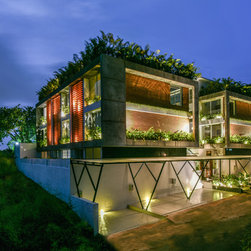
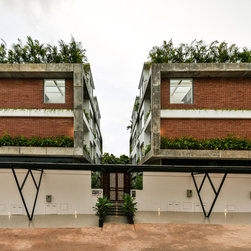
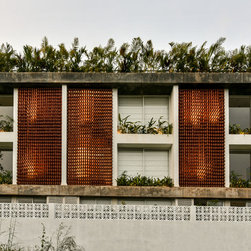
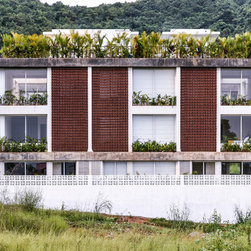
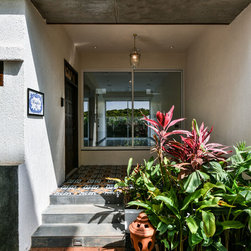
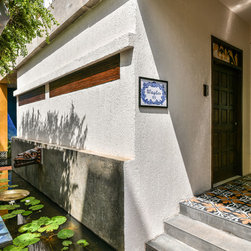
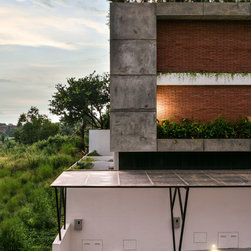
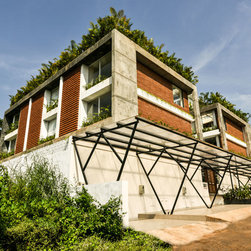
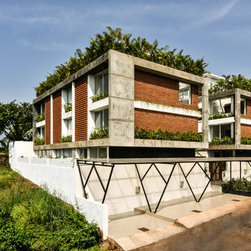
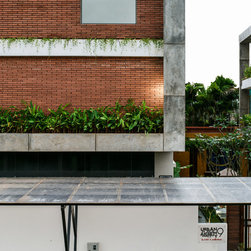
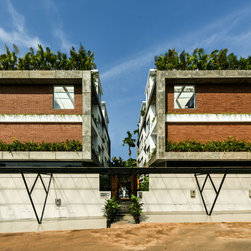
The visitor is greeted by a light weight steel structure atop which sits an I.P.S. (Indian patent stone) or exposed cement finish structure which envelopes a down to earth material palette comprising of terracotta bricks and various green hues of Heliconia and Vernonia plants. An offset within the façade, clad with polished black granite situated between the IPS and the steel structure helps define and blend the edges between both these masses.
A tree in nature is never static, it changes its appearance from one moment to the next. No one leaf remains the same. It is with this idea that the project was designed keeping in mind that the structure should be dramatic and yet deeply rooted to nature. We tried to achieve this through the use of planters placed at every floor which renders a sense of belonging to every resident.
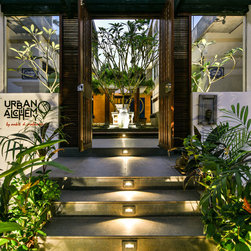
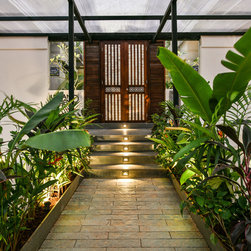
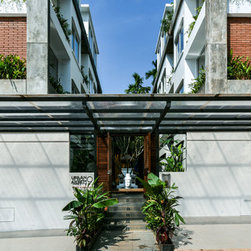
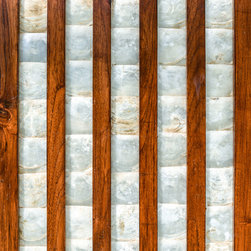
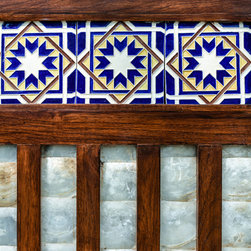
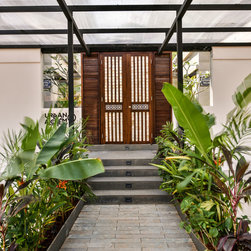
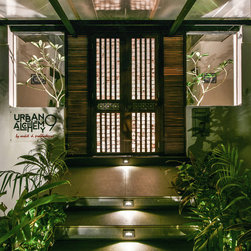
The entrance area is characterized by a teak wood paneled door with wooden louvers and clear glass openings on either side. Mother of pearl windows are a traditional element of the Goan culture and these shells filter in the sunlight rendering themselves translucent.
Frangipani or Plumeria trees visible through the clear glass openings offers the first glimpse of what lies within.
Goa has a tropical monsoon climate characterized by high humidity and temperatures soaring high during the dry spell. Thus, we decided to ensure natural air circulation by providing large openings positioned in such a way so as to optimize cross ventilation.
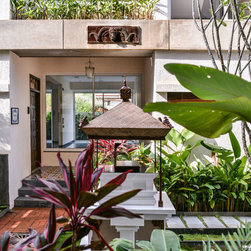
An open to sky courtyard has always been an important element of Goan Architecture with the Tulsi Vrindavan (Decorative Tulsi Pedestal with the holy Basil planted in it) or any other tree as its central focus. Another important element of a Goan-Portuguese house is the ‘balcao’ which is a traditional entrance porch with red oxide benches.
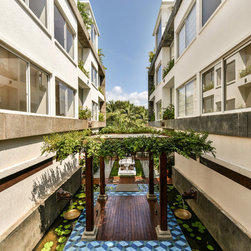
The villas are planned in such a way that a green offset or setback comprising of tropical plants is created on the side as well as the rear with a large open to sky courtyard in the center.
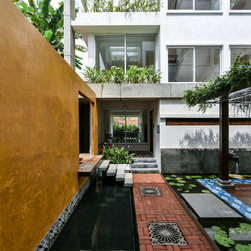
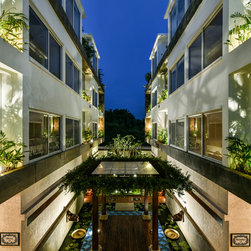
This central courtyard is the main spine consisting of paths that lead to the ‘balcao’ or entrance porch of each villa and is characterized by tropical plants, lotus ponds, black reflection pools and other vernacular artifacts.
The central courtyard could be envisioned into three areas, the entrance or the
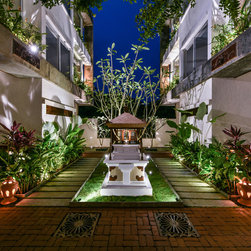
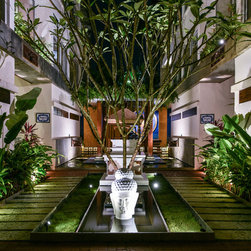
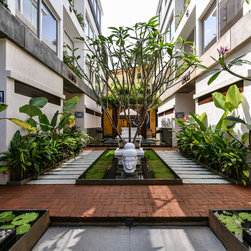
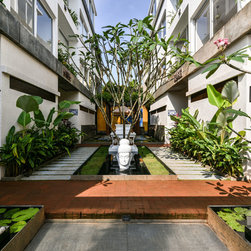
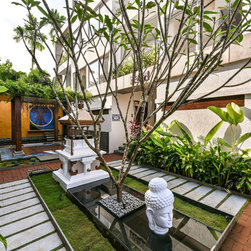
‘Padmasana’ court, the central or the ‘Living Pavilion’ court and the rear court. Two pink frangipani trees adorn the entrance lotus ponds on either side. An aged frangipani tree with its artistically sculpted branches creates intricate shadows over a white Buddha head handcrafted by local terracotta artistes in the Padmassana Court. The Buddha head is placed at the foot of the frangipani and is reflected by the pool of gently flowing water beneath it.
The branches of the frangipani tree are sculptural in its own way with its everlasting fragrance and exquisite shadows which are created as the sun rises and sets every day.
Goa shares a hidden bond and has a lot of similarities with Bali, Indonesia in terms of the tropical climate they share as well as the rituals and customs related to nature.
We felt it was important to honor this bond by designing ‘an empty throne shrine’ or the ‘Padmasana Shrine’.
The ‘Padmasana shrine’ is divided into three sections from the base to the top.
The bhur(world of demons), bhuwah(world of man), and swah(world of gods). The empty throne carved out of wood lets the viewer place in his mind any supreme power to worship on this pedestal. The circle of life is represented by the continuous flowing water which falls from the mid-section of the shrine into the black reflection pool and overflows from the edges back to the source.
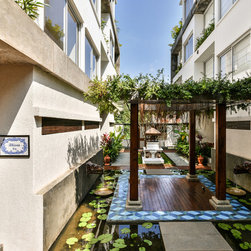
As we move through the side of the shrine along a rough kota finished pathway lined with lush green tropical plants like Heliconia, ornamental orange-purple bananas, Hibiscus, Ginger lily, Calathea, Cordyline, we are greeted with the first glimpse of the ‘Living Pavilion’ surrounded by a large lotus pond.
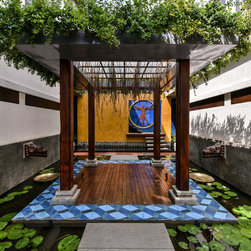
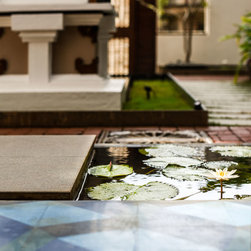
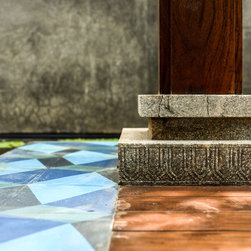
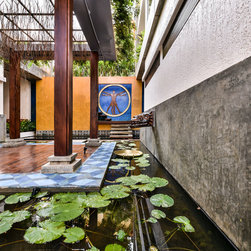
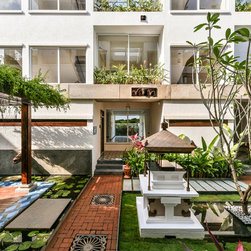
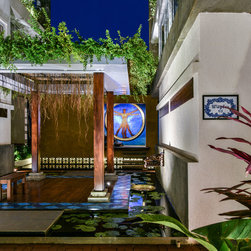
The pavilion is synthesized around the elements of a tree with the wooden columns acting as the main trunk upon which a plethora of fragrant flowering plants represent the foliage. The emphasis of the ‘Living pavilion’ is on the micro-details and the use of contrasting materials and surfaces like the hand chiseled granite pedestal base, the wooden columns, exposed cement finish (I.P.S. finish) and textured wall with wooden louvers bound around the transparent lotus pond.
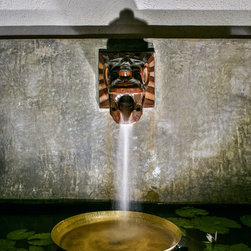
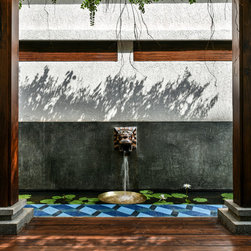
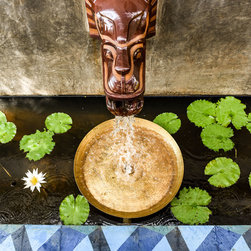
The cultural influence of Goa with its hundreds of years of rituals and customs are represented by terracotta handmade sculptures or grotesque Gargoyles custom designed and executed by Clay Club, Ahmedabad. The gushing sound of water from the mouth of these grotesque gargoyles into the hammered brass basin make one reminisce about the past that was and the present that is.
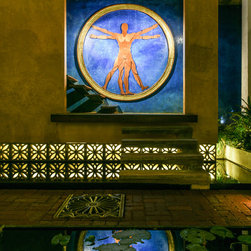
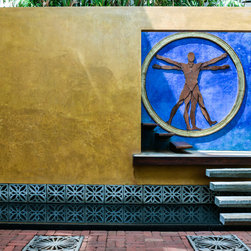
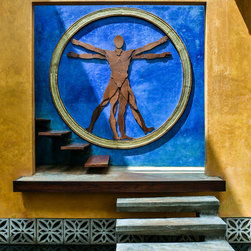
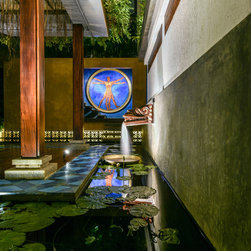
As we move across the ‘Living Pavilion’ area, we can’t help but transfix our sight on the wooden human figure with arms wide open placed within a relief brass ring. Two exposed coloured cement walls, one in yellow ochre and the other in Yves Klein blue colour placed one behind the other act as a backdrop for this coalesced rendition of the ‘Vitruvian Man’.
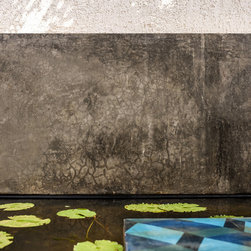
The back lit precast concrete screens placed side by side below the yellow ochre wall makes it look suspended over the black reflection pool.
The ‘Vitruvian man’ was conceptualized by the ever so famous artist Leonardo Da Vinci in around 1490. It represents the golden proportions in nature which is the focal point from which everything radiates. It is the missing link that connects nature to humans and eventually to built structures. It was thus apt to represent this concept by designing a custom-made genesis of the original ‘Vitruvian man’ which hints the connection between the built structure and the landscape elements to the viewer.
All these elements create a beautiful echo of colours like yellow ochre, Klein blue, texture of wood, and brass relief work over a black reflection pool below. A custom designed concrete cantilevered staircase followed by a suspended steel staircase leads the visitor to the fruit orchard area in the backyard of the project.
The villas themselves are designed in such a way that nothing is indoors. The large sliding glass windows connect the central courtyard to the green backyard of the villas. The ‘balcao’ or the entrance porch acts as a transition space between the living-dining area and the central courtyard.The black-ochre heritage pattern flooring in the ‘balcao’ area compliments the red oxide bench and an antique style inverted glass bell jar hanging lamp adds the sculptural element to the area by creating a rippling shadow effect once lit.
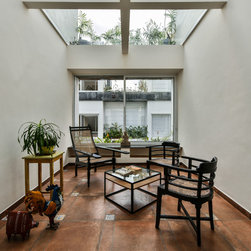
The villa comprises of three floors, the public area like the living, dining and kitchen on the ground floor; private areas like two bedrooms on the first floor, master bedroom with sky lit study area on the second floor and a roof garden on the terrace level.
Planters made up of heliconia, hibiscus, ginger lily and other tropical plants adjoin all the internal spaces with a bay window overlooking the central courtyard and backyard. These planters visually connect the inhabitant to nature not only on the ground, but on all the other floors as well.
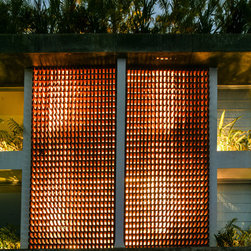
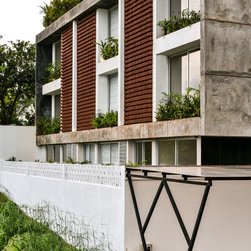
The area adjoining the bathrooms is designed to fit in all the services and is covered with semi-open custom designed brick screen. The brick work is designed in such a way that each brick offsets from the next in an open work pattern, wrapping the walls in a permeable blanket that creates dappled daylight in particular spaces and, at night, when all the lights are on inside, the building will be seen from the streets like a glowing lattice Work. While designing Urban Alchemy 9, we tried to adopt holistic approach, balancing
architecture with nature and interiors, drawing on the strengths of each, and culminating in a residential enclave that exudes all the qualities desired in a home.
We tried to develop a clear understanding of the need to create diversity in space from private to semiprivate and public, with each typical unit configuration large openings, landscape elements and reflective pools.
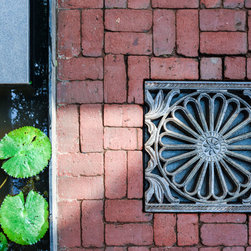
The array of materials is used in such a way that it creates an assemblage of textures which reflect and blend the old and new. The culmination of the traditional building techniques and the present styles is reflected through the use of hand-made bricks (old) and concrete (new).
The mélange created by the confluence of these various textures and elements helps us reminisce the Goa that was.
Urban Alchemy 9, is a social experiment by which we tried to capture the essence of Goa by trying to strike the perfect balance between functionality, design, history, culture and most importantly nature.
The project comprises of six identical bungalows sharing a common wall with each other. It is located along the foothills of the southern town of Margao, in Goa, India. The relationship of architecture to nature and the other arts is a crucial one. Goa has had a deep influence of 400 years of Portuguese rule over its art, architecture and culture.
What evolved from this is a genesis of vernacular styles with a backdrop of innovative materials through trade. The most important challenge while designing this project was to honor this history while blending it with the prevalent needs of the present era.
It is the journey to explore each and every space within the project which was most important to us. The spaces are never revealed at once, as the intent was to create curiosity and mystery so that every visitor could explore the area and chance upon a nuance at every step.
The visitor is greeted by a light weight steel structure atop which sits an I.P.S. (Indian patent stone) or exposed cement finish structure which envelopes a down to earth material palette comprising of terracotta bricks and various green hues of Heliconia and Vernonia plants. An offset within the façade, clad with polished black granite situated between the IPS and the steel structure helps define and blend the edges between both these masses.
A tree in nature is never static, it changes its appearance from one moment to the next. No one leaf remains the same. It is with this idea that the project was designed keeping in mind that the structure should be dramatic and yet deeply rooted to nature. We tried to achieve this through the use of planters placed at every floor which renders a sense of belonging to every resident.
The entrance area is characterized by a teak wood paneled door with wooden louvers and clear glass openings on either side. Mother of pearl windows are a traditional element of the Goan culture and these shells filter in the sunlight rendering themselves translucent.
Frangipani or Plumeria trees visible through the clear glass openings offers the first glimpse of what lies within.
Goa has a tropical monsoon climate characterized by high humidity and temperatures soaring high during the dry spell. Thus, we decided to ensure natural air circulation by providing large openings positioned in such a way so as to optimize cross ventilation.
An open to sky courtyard has always been an important element of Goan Architecture with the Tulsi Vrindavan (Decorative Tulsi Pedestal with the holy Basil planted in it) or any other tree as its central focus. Another important element of a Goan-Portuguese house is the ‘balcao’ which is a traditional entrance porch with red oxide benches.
The villas are planned in such a way that a green offset or setback comprising of tropical plants is created on the side as well as the rear with a large open to sky courtyard in the center.
This central courtyard is the main spine consisting of paths that lead to the ‘balcao’ or entrance porch of each villa and is characterized by tropical plants, lotus ponds, black reflection pools and other vernacular artifacts.
The central courtyard could be envisioned into three areas, the entrance or the
‘Padmasana’ court, the central or the ‘Living Pavilion’ court and the rear court. Two pink frangipani trees adorn the entrance lotus ponds on either side. An aged frangipani tree with its artistically sculpted branches creates intricate shadows over a white Buddha head handcrafted by local terracotta artistes in the Padmassana Court. The Buddha head is placed at the foot of the frangipani and is reflected by the pool of gently flowing water beneath it.
The branches of the frangipani tree are sculptural in its own way with its everlasting fragrance and exquisite shadows which are created as the sun rises and sets every day.
Goa shares a hidden bond and has a lot of similarities with Bali, Indonesia in terms of the tropical climate they share as well as the rituals and customs related to nature.
We felt it was important to honor this bond by designing ‘an empty throne shrine’ or the ‘Padmasana Shrine’.
The ‘Padmasana shrine’ is divided into three sections from the base to the top.
The bhur(world of demons), bhuwah(world of man), and swah(world of gods). The empty throne carved out of wood lets the viewer place in his mind any supreme power to worship on this pedestal. The circle of life is represented by the continuous flowing water which falls from the mid-section of the shrine into the black reflection pool and overflows from the edges back to the source.
As we move through the side of the shrine along a rough kota finished pathway lined with lush green tropical plants like Heliconia, ornamental orange-purple bananas, Hibiscus, Ginger lily, Calathea, Cordyline, we are greeted with the first glimpse of the ‘Living Pavilion’ surrounded by a large lotus pond.
The pavilion is synthesized around the elements of a tree with the wooden columns acting as the main trunk upon which a plethora of fragrant flowering plants represent the foliage. The emphasis of the ‘Living pavilion’ is on the micro-details and the use of contrasting materials and surfaces like the hand chiseled granite pedestal base, the wooden columns, exposed cement finish (I.P.S. finish) and textured wall with wooden louvers bound around the transparent lotus pond.
The cultural influence of Goa with its hundreds of years of rituals and customs are represented by terracotta handmade sculptures or grotesque Gargoyles custom designed and executed by Clay Club, Ahmedabad. The gushing sound of water from the mouth of these grotesque gargoyles into the hammered brass basin make one reminisce about the past that was and the present that is.
As we move across the ‘Living Pavilion’ area, we can’t help but transfix our sight on the wooden human figure with arms wide open placed within a relief brass ring. Two exposed coloured cement walls, one in yellow ochre and the other in Yves Klein blue colour placed one behind the other act as a backdrop for this coalesced rendition of the ‘Vitruvian Man’.
The back lit precast concrete screens placed side by side below the yellow ochre wall makes it look suspended over the black reflection pool.
The ‘Vitruvian man’ was conceptualized by the ever so famous artist Leonardo Da Vinci in around 1490. It represents the golden proportions in nature which is the focal point from which everything radiates. It is the missing link that connects nature to humans and eventually to built structures. It was thus apt to represent this concept by designing a custom-made genesis of the original ‘Vitruvian man’ which hints the connection between the built structure and the landscape elements to the viewer.
All these elements create a beautiful echo of colours like yellow ochre, Klein blue, texture of wood, and brass relief work over a black reflection pool below. A custom designed concrete cantilevered staircase followed by a suspended steel staircase leads the visitor to the fruit orchard area in the backyard of the project.
The villas themselves are designed in such a way that nothing is indoors. The large sliding glass windows connect the central courtyard to the green backyard of the villas. The ‘balcao’ or the entrance porch acts as a transition space between the living-dining area and the central courtyard.The black-ochre heritage pattern flooring in the ‘balcao’ area compliments the red oxide bench and an antique style inverted glass bell jar hanging lamp adds the sculptural element to the area by creating a rippling shadow effect once lit.
The villa comprises of three floors, the public area like the living, dining and kitchen on the ground floor; private areas like two bedrooms on the first floor, master bedroom with sky lit study area on the second floor and a roof garden on the terrace level.
Planters made up of heliconia, hibiscus, ginger lily and other tropical plants adjoin all the internal spaces with a bay window overlooking the central courtyard and backyard. These planters visually connect the inhabitant to nature not only on the ground, but on all the other floors as well.
The area adjoining the bathrooms is designed to fit in all the services and is covered with semi-open custom designed brick screen. The brick work is designed in such a way that each brick offsets from the next in an open work pattern, wrapping the walls in a permeable blanket that creates dappled daylight in particular spaces and, at night, when all the lights are on inside, the building will be seen from the streets like a glowing lattice Work. While designing Urban Alchemy 9, we tried to adopt holistic approach, balancing
architecture with nature and interiors, drawing on the strengths of each, and culminating in a residential enclave that exudes all the qualities desired in a home.
We tried to develop a clear understanding of the need to create diversity in space from private to semiprivate and public, with each typical unit configuration large openings, landscape elements and reflective pools.
The array of materials is used in such a way that it creates an assemblage of textures which reflect and blend the old and new. The culmination of the traditional building techniques and the present styles is reflected through the use of hand-made bricks (old) and concrete (new).
The mélange created by the confluence of these various textures and elements helps us reminisce the Goa that was.
Urban Alchemy 9, is a social experiment by which we tried to capture the essence of Goa by trying to strike the perfect balance between functionality, design, history, culture and most importantly nature.
Project Year: 2017
Project Cost: ₹3,00,00,001 - ₹5,00,00,000
Country: India